

TL;DR:
AI “coworkers” aren’t chatbots you ask questions. They’re persistent agents that proactively do work alongside you; scheduling, monitoring, drafting, flagging. The data says they boost efficiency by ~20%, not 10x. The biggest gains come from augmentation, not from replacing AI with humans.
I believe, the future isn’t humans vs. AI. It’s humans + AI teams. This article breaks down what that actually looks like, what the real concerns are, and how to prepare without panicking.
Welcome👋🏻
I am a Software Engineer with 10+ years of experience. My goal is to close the gap between the technical and the non-technical, making AI accessible to everyone, regardless of their background.
It’s Monday morning. You open your laptop, coffee in your hand, bracing for the usual chaos. But your calendar is already organized. Your emails are prioritized. Your first meeting has a prep doc waiting in your inbox.
You didn’t do any of this.
Your AI coworker did. Over the weekend. While you were doing something actually human, like ignoring your phone at Easter brunch.
This isn’t science fiction anymore. And it’s not even next year. Some companies like Salesforce is already deploying agents that handle real workflows; delivering agentic IT and HR solutions. And the shift from “AI will replace us” to “AI will work with us” is happening faster than most people realize.
Here’s what that actually means for your day-to-day, and what to do about it.
What Is an AI Coworker? (And Why It's Not a Chatbot)
Let me save you some time: an AI coworker is not a chatbot you type questions into.
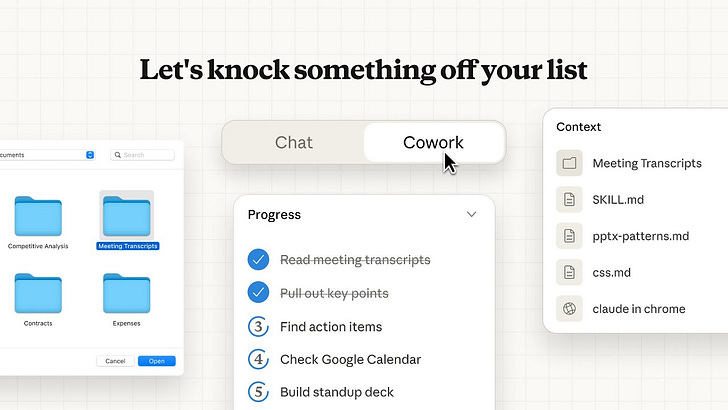
We call this an “AI agent”, but it is a digital teammate that proactively does work on your behalf. The difference matters. A chatbot waits for you. An AI coworker shows up with work already done.
There are three flavors worth understanding, and they sit on a spectrum of independence:
Task Agents: These handle specific, repeatable workflows. Scheduling meetings, entering data, pulling research. Think of them as a very reliable intern who never forgets a step.
Collaborative Agents: These work with you in real-time. Coding alongside you, drafting copy while you edit, analyzing data while you interpret. You’re both in the kitchen at the same time.
Persistent Agents: These are always on. Monitoring your campaigns, watching your inbox, flagging anomalies at 2 AM. They don’t clock out.

The thing most people miss is that these agents don’t replace a person in a chair. They replace the tasks that were eating that person alive. That’s a different thing entirely, and it’s where we need to focus.
What the Productivity Data Actually Shows: AI Augmentation vs. Replacement
Here’s what’s actually happening in the numbers:
According to recent Anthropic report, software developers lead the pack, accounting for 19% of the total gains. The rest of the top five might surprise you: operations managers (6%), marketers (5%), customer service reps (4%), and high school teachers (3%).
I know. That sounds underwhelming compared to the “10x productivity” headlines. Good. Because realistic expectations are the single greatest defense against disappointment.
~20% productivity gain is not a small number. If you spend 10 hours a week on finding a bug, writing a documentation, analyzing a different code base, a 20% efficiency gain hands you back 2 hours. Every week. That’s 100 hours a year. That’s 2,5 weeks of working full time redirected toward things that actually require your brain.
But here’s the key insight that most of the hype-cycle articles skip: the biggest gains come from augmentation, not from replacement. The companies seeing real results aren’t firing people and plugging in AI. They’re giving their existing people AI teammates and watching what happens when humans spend more time on judgment, strategy, and creativity.
The AI does the prep work. The human makes the call.
That’s the model. It’s not flashy. But it works.
AI Coworker in Practice: 3 Real-World Scenarios
Theory is nice. Let me show you three scenarios that make this concrete.
Scenario A: The Marketing Manager
Your AI coworker monitors campaign performance overnight. While you sleep, it spots that your Facebook ad spend is burning cash on an audience segment that stopped converting two days ago. It flags the anomaly, suggests reallocating budget to your top-performing Instagram set, drafts a morning summary report, and schedules a team sync for 9:30 AM.
You walk in, review the recommendation, and make the call. Yes, shift the budget. No, hold off on pausing that experiment.
The AI did the monitoring and the math. You did the judgment.
Scenario B: The Software Engineer
This one’s personal for me. Tools like Claude Code already handle boilerplate and debugging. The AI writes the repetitive scaffolding; the API endpoint that looks like the last 15 you built. It catches the null pointer exception you would have spent 40 minutes hunting.
The human focuses on architecture and user experience. The “why are we building this” and “how should this feel” questions that no model is answering well yet.
Bloomberg reported on a “productivity panic” in engineering; are we just coding faster, or are we coding better? I think about this a lot. Faster is easy to measure. Better is what matters. And “better” still requires a human who understands the problem deeply enough to know when the AI’s suggestion is technically correct but architecturally wrong.
Speed without direction is just expensive chaos.
Scenario C: The Small Business Owner
You run a local service business. Your AI coworker handles customer inquiries at 11 PM when someone finds your website after hours. It books appointments based on your real-time availability. It sends you inventory alerts when stock drops below your threshold.
You focus on the things that actually grow a small business: relationships, reputation, and showing up as a human in a full of automated competitors.
The pattern across all three scenarios is the same: AI handles the “keeping the lights on” work. You handle the “deciding where to point the lights” work.
Will AI Replace My Job? The Real Concerns, Addressed Honestly
I’m not going to pretend this is all upside. There are real tensions here, and dismissing them would be dishonest. So let’s walk through them plainly.
Job Displacement: “Will I lose my job?”
Some roles will shrink. That’s the honest answer. Data entry, basic report generation, first-tier customer support; these are already being absorbed by agents. But new roles are emerging alongside them: AI ethics consultants, automation architects, AI engineers, people who manage and audit AI systems.
The pattern isn’t new. Spreadsheets didn’t eliminate accountants. They eliminated the version of accounting that was purely manual calculation, and created space for analysis and advisory work. The transition is real, though. And pretending it’s painless would be a lie.
Skill Atrophy: “If AI does everything, do I lose competence?”
This is the “calculator debate” for the AI age. When calculators arrived, people worried we’d forget how to do math. We did, sort of. But we gained the ability to solve problems that were previously impossible because we weren’t spending all our time on long division.
The risk is real. If you never write a first draft yourself, your writing muscle weakens. If you never debug manually, your diagnostic instinct fades. The answer isn’t to avoid AI; it’s to be intentional about which skills you keep sharp and which ones you deliberately offload.
The Productivity Trap: “Am I just expected to do more?”
This one keeps me up at night. If AI saves you 2 hours a week, does your company give you breathing room, or do they fill those 2 hours with more output expectations?
Historically, productivity tools have been used to increase throughput, not decrease working hours. I don’t have a clean answer here. But I think the people who set boundaries early; who say “I’m using AI to do better work, not just more work”; will be the ones who actually benefit.
Transparency: “How do I know what it did or why?”
When your coworker is human, you can ask them to walk you through their reasoning. When your coworker is an AI, you need audit trails, logs, and a habit of checking the work. This is the management skill most people haven’t built yet. You need to learn to review AI output the way a senior engineer reviews a junior engineer’s code: trust but verify, every time.
How to Prepare for AI Coworkers: 4 Practical Steps
Here’s what I’d actually do if I were starting from zero today. These are four shifts in mindset, each with a concrete step attached.
1. How to Delegate Tasks to AI (Like a Manager, Not a User)
This is the skill that separates people who get value from AI and people who don’t. Delegating to AI is exactly like managing a junior employee: you need to give clear instructions, set expectations, and check the work.
Most people either over-trust (hand everything off and never review) or under-trust (micromanage every output and waste the time savings). The sweet spot is structured delegation.
Here’s a prompt to practice this right now:
I need you to act as my Monday morning prep assistant.
Here are my priorities for this week: [paste your top 3-5 priorities].
Review the following emails [paste or describe your inbox] and:
(1) flag anything that’s urgent and related to my priorities,
(2) draft a one-paragraph summary of what needs my attention today,
(3) suggest one thing I can defer to Wednesday or later. Be direct. No filler.
Paste that into Claude or Gemini with your actual priorities and inbox summary. See what comes back. Adjust the instructions based on what was useful and what wasn’t. That adjustment process? That is the skill.
2. The Skills AI Can't Replace: Why Human Judgment Still Wins
Critical thinking. Creativity. Empathy. Ethical reasoning.
These are the skills that become more valuable, not less, when AI handles the routine work.
The question to keep asking yourself: “What am I doing right now that requires me to be a human”? If the answer is “nothing”, you’re doing AI’s job. Swap.
3. How to Experiment with AI Tools Before Your Company Makes You
Experiment with tools before they’re mandated by your company.
If you want to try this today:
Pick one repetitive task you do every week (email sorting, meeting prep, report drafting).
Open Claude or Gemini.
Describe the task in plain English and ask the AI to do it with a sample input.
Evaluate the output: What was good? What was wrong? What instructions would you change?
Run it again with better instructions.
That’s one cycle. Do five of those and you’ll understand more about AI collaboration than most “AI strategy” workshops teach in a full day.
4. The One Question That Reframes Your Relationship with AI
When your company inevitably adopts AI tools, don’t ask “Is this going to replace me”? Ask: “What will I do that the AI can’t”?
That question reframes you from a potential victim to the person defining the human-AI split on your team. It’s a power move disguised as a question.

The Human Element: Why Managing AI Is Still a Deeply Human Skill
Here’s what I keep coming back to: AI coworkers aren’t coming for your job. They’re coming to your job. There’s a difference, and it matters.
A coworker who handles your Monday morning chaos so you can walk into work thinking about strategy instead of a repetitive work? That’s not a threat. That’s a teammate. A persistent agent that catches the budget anomaly at 2 AM so you can make the call at 9 AM? That’s not replacement. That’s augmentation.
But here’s the part I’m still working through myself: the line between “AI handles the grunt work” and “AI handles so much that I forget how to do my own job” is blurry. It moves. And it requires honest, ongoing attention.
I believe, the people who will thrive in this shift aren’t the ones who resist AI and aren’t the ones who surrender everything to it. They’re the ones who learn to manage it; like a coworker, not like a magic button.
Clear instructions. Regular check-ins. Honest evaluation of the output. That’s management. And it turns out, managing an AI teammate well is a deeply human skill.
Two questions if you’re up for it:
What’s the one recurring task in your week that you’d hand to an AI coworker tomorrow if you could? What’s actually stopping you from trying it today?
Have you already hit the “productivity trap”; where AI saved you time but your workload just expanded to fill it? How did you handle it?
Leave your comment below, I read everything.
PS: If you're new here and wondering why a software engineer is writing about all this - here's why I started Becoming with AI."
The "manage it like a coworker" framing works until you ask: who is the coworker, exactly? I have recently been thinking about the issue of Agent identity. Your human colleague has a reputation, a contract, an email address. When an agent acts through your account, the outside world sees only you. Audit trails help, but they're a workaround for a problem that hasn't been solved at the infrastructure level yet — agent identity. Until that exists, you're not really managing a coworker. You're co-signing everything it does.
The 20% reframe is the most useful thing in a piece full of useful things — taking a number that sounds underwhelming and doing the actual arithmetic of 100 hours a year is the kind of grounding most AI writing deliberately avoids. Just curious to know, how do you personally draw the line between offloading and atrophying?